

Re-Wilding the West: Wolves, Bison, and Thinking Bigger for the Future
Thursday, October 2, 2025 | Natural History Museum, 7-8 PM
This event is free and open to the public.
Join us for a talk by Sean Robert Gerrity, author of Wild on Purpose and founder of the American Prairie Reserve, to discuss his re-wilding work in Montana, and what it might teach us about the future of ecological conservation and biodiversity across the American West.
Sean Gerrity is a conservation entrepreneur best known as the founder and former CEO of the American Prairie Reserve, one of the largest and most ambitious landscape-scale conservation projects currently underway in the United States. Established in 2001, the goal of the project is to assemble and restore the habitat and wildlife on a three and quarter million-acre wildlife reserve: larger than Yellowstone National Park and Glacier National Park combined.
With a background in business consulting from Silicon Valley, Gerrity brings a strategic and innovation mindset to conservation. His seventeen-year leadership history with American Prairie earned recognition from National Geographic and the National Wildlife Federation.
Gerrity is the author of the book: Wild on Purpose: The Story of the American Prairie and The Art of Thinking Bigger published by Torrey House Press.
He remains actively engaged in global conservation efforts, including as host of the podcast The Answers Are Out There. He serves on the Council of Advisors with Tanzanian-based African People & Wildlife, Namibia’s Orange River-Karoo Conservation Area, The Kratt Brothers Creature Hero Foundation and Adventure Scientists.

Beyond the Glittering World: Indigenous Feminisms and Futurisms
Thursday, November 20, 2025 | Finch Lane Gallery, 7-8 PM
This event is free and open to the public.
Join us for a series of lively readings by the writers and poets Stacie Shannon Denetsosie, Kinsale Drake, and Darcie Little Badger as they launch their groundbreaking new anthology, Beyond the Glittering World: An Anthology of Indigenous Feminisms and Futurisms. This anthology brings together twenty emerging and established Native women writers and writers of marginalized genders, presenting an array of singular voices at their genre-bending, boundary-breaking, and joyous best.
Stacie Shannon Denetsosie is the award-winning author of The Missing Morningstar and Other Stories (Torrey House Press, 2023), a finalist for the PEN/Bingham Prize and the Reading the West Award in Debut Fiction, and the winner of the Women Writing the West WILLA Award in Multiform Fiction and a Gold Foreward Indies Award.
Stacie is a graduate of the MFA program at the Institute of American Indian Arts and holds an MA from Utah State University. An enrolled member of the Navajo Nation, she is Todích'íí'nii (Bitterwater Clan), born for Naakaii (Mexican Clan), her maternal grandparents are Tł'ízí lání (Many Goats), and her parental step-grandparents are Bilagáana (European American). She is from the Navajo Nation. She lives in Northern Utah with her husband and cat.
Kinsale Drake (Diné) is a winner of the 2023 National Poetry Series for her debut poetry collection THE SKY WAS ONCE A DARK BLANKET (University of Georgia Press, 2024). Her work has appeared in Poetry Magazine, Poets.org, Best New Poets, Black Warrior Review, and elsewhere. She directs programming for NDN Girls Book Club, which distributes free books to Indigenous youth and communities, and lives in Nashville, TN.
Darcie Little Badger is a Lipan Apache writer with a PhD in oceanography. Her critically acclaimed debut novel, Elatsoe, was featured in Time Magazine as one of the best 100 fantasy books of all time. Elatsoe also won the Locus Award for Best First Novel and was a Nebula, Ignyte, and Lodestar finalist. Her second fantasy novel, A Snake Falls to Earth, received a Nebula Award, an Ignyte Award, and a Newbery Honor and was longlisted for the National Book Award. Her third book, Sheine Lende, a prequel to Elatsoe, was a USA Today bestseller. Darcie is married to a veterinarian named Taran.

Instagram, Trad Wives, and Evolutions in Mormon Feminism
Wednesday, January 14, 2026 | Jewel Box, CTIHB, 3:30-5:00PM
This event is free and open to the public.
Join us for a fascinating conversation with Dr. Caroline Kline about the complex and controversial popularity of the trad wife movement, how it connects to Mormon women’s history, and what this Instagram trend might tell us about our current ideas and fantasies about American feminism.
Caroline Kline is Research Assistant Professor at Claremont Graduate University and Co-Editor of Dialogue: A Journal of Mormon Thought. She holds a PhD in religion from CGU, and her areas of interest include contemporary Latter-day Saint women's communities, feminist theory, and oral history. Her book, Mormon Women at the Crossroads: Global Narratives and the Power of Connectedness (2022), explores Latter-day Saint women's lived experiences in Botswana, Mexico, and the United States.
This event is sponsored in part by the Department of History and the Tanner Humanities Center.

Robert Sullivan
Thursday, February 5, 2026 | LNCO 3:30-5:00PM
This event is free and open to the public.
Please join us for this year’s annual American West Lecture, “Double Exposure: Photography and the Civil War in the American West,” delivered by Robert Sullivan. This talk, based on Sullivan’s book by the same title, documents the life of Timothy O’Sullivan, America’s most famous war photographer, whose photo “A Harvest of Death,” taken at Gettysburg, is an icon of the Civil War. The images of the American West O’Sullivan made after the war, while traveling with the surveys led by Clarence King and George Wheeler, display a prescient awareness of what photography would become; years later, Ansel Adams would declare his work “surrealistic and disturbing.” Double Exposure documents O’Sullivan’s career and impact on American photography, while also charting the long-lasting impact the Civil War had on the American West.
Robert Sullivan is the author of many books, including Rats, The Meadowlands, My American Revolution, The Thoreau You Don't Know, and most recently, Double Exposure: Resurveying the West with Timothy O'Sullivan, America's Most Mysterious War Photographer. His work appears in The New Yorker, The New York Times, and A Public Space, where he is a contributing editor. He is the recipient of a 2022 Guggenheim Fellowship and, in 2024, won the American Academy of Arts and Letters award for literature.

Disabled Ecologies: A Multispecies Reckoning
Wednesday, March 18, 2026 | LNCO 2110, 3:30-5:00 PM
This event is free and open to the public.
Please join us for a groundbreaking talk by Dr. Sunaura Taylor from her newest book, Disabled Ecologies, which tells the story of a Tucson aquifer forever altered by a Superfund site, and the contamination’s ripple effects through the largely Mexican American community living above. Drawing on her own complex relationship to this long-ago injured landscape, Taylor takes us with her to follow the site's disabled ecology—the networks of disability, both human and wild, that are created when ecosystems are corrupted and profoundly altered. Disabled Ecologies maps out alternative modes of connection, solidarity, and resistance—an environmentalism of the injured. An original and deeply personal reflection on what disability means in an era of increasing multispecies disablement.
Sunaura Taylor is an artist and writer. She is the author of Beasts of Burden: Animal and Disability Liberation (The New Press, 2017), which received the 2018 American Book Award. Taylor has written for a range of popular media outlets and her artworks have been exhibited widely both nationally and internationally. She works at the intersection of disability studies, environmental justice, multispecies studies, and art practice. She is an Assistant Professor in the Department of Environmental Science, Policy, and Management at the University of California, Berkeley. Her latest book is Disabled Ecologies: Lessons from a Wounded Desert (University of California Press, 2024).
This event is sponsored in part by Environmental Humanities, the Tanner Humanities Center, and Disability Studies.
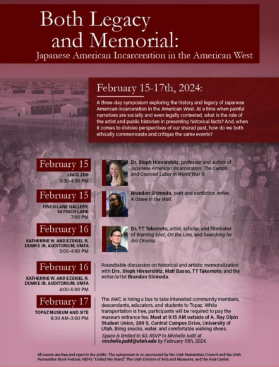
Both Legacy and Memorial: Japanese American Incarceration in the American West, is
a three-day symposium exploring the history and legacy of Japanese American incarceration
in the American West. At a time when painful narratives are socially and even legally
contested, what is the role of the artist and public historian in presenting historical
facts? What does a new American memorial for Japanese Americans in the West look like?
And, when it comes to divisive perspectives of our shared past, how do we both ethically
commemorate and critique the same events?
All of these events are free and open to the public. (For the tour on Sat, Feb. 17th,
participants will need to pay the museum fee.) Hope to see you there!
This event is done in partnership with Utah Division of Arts & Museums, Utah Humanities,
and The National Endowment for the Arts.
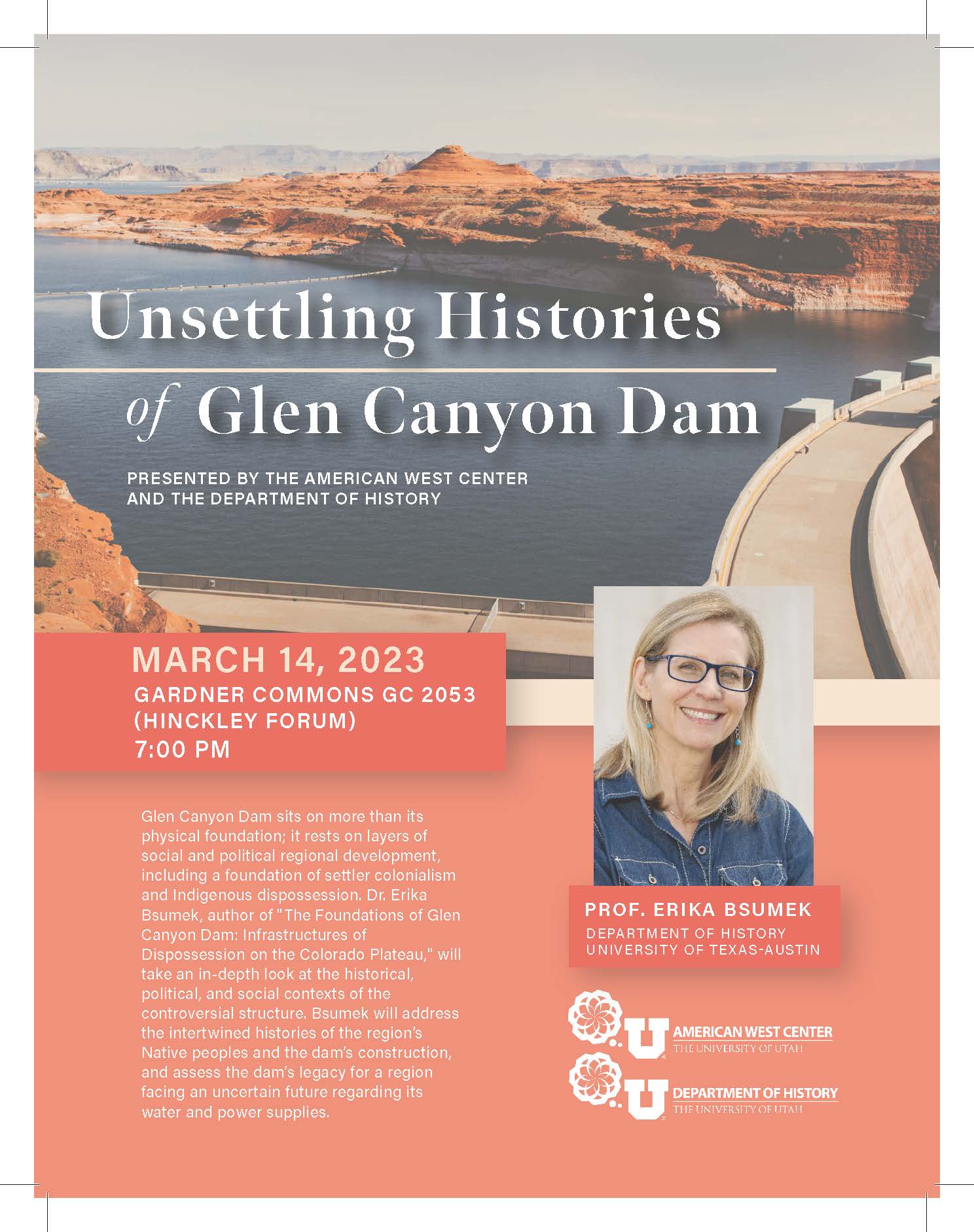 Glen Canyon Dam sits on more than its physical foundation; it rests of layers of social
and political regional development, including a foundation of settler colonialism
and Indigenous dispossession. Dr. Erika Bsumek, author of the "The Foundation of Glen
Canyon Dam: Infrastructures of Dispossession on the Colorado Plateau," will take an
in-depth look at the historicial, political, and social contexts of the controversial
structure. Bsumek will address the intertwined histories of the region's Native people
and the dam's legacy for a region facing an uncertain future regarding its water and
power supplies.
Glen Canyon Dam sits on more than its physical foundation; it rests of layers of social
and political regional development, including a foundation of settler colonialism
and Indigenous dispossession. Dr. Erika Bsumek, author of the "The Foundation of Glen
Canyon Dam: Infrastructures of Dispossession on the Colorado Plateau," will take an
in-depth look at the historicial, political, and social contexts of the controversial
structure. Bsumek will address the intertwined histories of the region's Native people
and the dam's legacy for a region facing an uncertain future regarding its water and
power supplies.
The tale of European settlement of North America has been told countless times, but not from the perspective of the land's original inhabitants. Now, PBS's acclaimed history series, AMERICAN EXPERIENCE, in association with Native American Public Telecommunications, is changing that with a groundbreaking mini-series and compelling multi-media project that, for the first time, tells the incredible Native American story through Native American eyes.
Five 90-minute documentaries spanning 300 years tell the story of pivotal moments
in U.S. history from the Native American perspective. "We Shall Remain" premieres
on KUED-Channel 7 Monday, April 13, at 8 p.m., and runs for five consecutive Monday
evenings through May 11.
KUED was selected to be the pilot PBS station to develop a massive production/outreach
project in conjunction with the national series. The centerpiece of the KUED project
consists of five companion half-hour documentaries, each focusing on one of Utah's
five tribes. The documentaries, which will be paired with the national series, air
at the end of each "We Shall Remain" episode. "This project marks the culmination
of three years of planning with more than 20 community partners," says Mary Dickson,
KUED director of Creative Services. "It is the largest diversity project ever undertaken
by KUED."
To extend the reach of the KUED productions, the Utah State Legislature allocated funds through the Utah Division of Indian Affairs in the Utah Department of Community and Culture to provide the KUED documentaries and a companion curriculum guide to each public school and library in the state.
The long-awaited AMERICAN EXPERIENCE series, "We Shall Remain," narrated by actor Benjamin Bratt, focuses on important historical events, telling five, sometimes heartbreaking but always inspiring, and little-known stories.
They were charismatic and forward thinking, imaginative and courageous, compassionate and resolute, and, at times, arrogant, vengeful and reckless. For hundreds of years, Native American leaders from Massasoit, Tecumseh, and Tenskwatawa, to Major Ridge, Geronimo, and Fools Crow, valiantly resisted expulsion from their lands and fought the extinction of their culture. Sometimes, their strategies were militaristic, but more often they were diplomatic, spiritual, legal, and political.
The series begins in the 1600s with the Wampanoags, who used their alliance with the English in Southern New England, and ends with the bold new leaders of the 1970s, who harnessed the momentum of the Civil Rights Movement to forge a pan-Indian identity. We Shall Remain upends two-dimensional stereotypes of American Indians as simply ferocious warriors or peaceable lovers of the land.
"You can't understand America in the 21st century if you don't understand the Native experience," says Chris Eyre, director of the first three episodes, who has been involved with the series from its outset and was director of "Smoke Signals." "What connects these five films is the resolve of their characters. This country is founded on people striving, being tenacious and moving forward ... this is a look at that, through Native eyes."
After the Mayflower (April 13) begins in New England in the 1620s, at the time of the so-called "first Thanksgiving." In March of 1621, Massasoit, chief of the Wampanoag, negotiated a diplomatic alliance with a scraggly band of English settlers for the benefit of his people. It was a gamble that paid off for several decades, as Indians and colonists coexisted in relative peace. A half-century later, as a brutal war flared between the English colonists and a confederation of New England Indians, the wisdom of Massasoit's choice seemed less clear.
Tecumseh's Vision (April 20) tells the story of the Shawnee leader Tecumseh and his brother, Tenskwatawa, known as the Prophet. In the years following the American Revolution, the Prophet led a spiritual revival movement that drew thousands of followers from tribes across the Midwest. His brother forged a pan-Indian political and military alliance from that movement, coming closer than anyone since to creating an independent Indian state.
Trail of Tears (April 27) explores the resolve and resilience of the Cherokee Nation, who resisted removal from their homelands in the Southeast in every way they knew: assimilating, adopting a European-style government and legal system, accepting Christianity, and even taking their case all the way to the U.S. Supreme Court.
Geronimo (May 4) takes place at the end of the Indian Wars, near the close of the nineteenth century. Here, desperate times catapulted a controversial character to the leadership of an Apache band. To angry whites, Geronimo was an archenemy, the perpetrator of unspeakable savage cruelties. To some Apaches, he was a stubborn troublemaker whose actions needlessly brought the enemy's wrath upon them. To his supporters, he remained the embodiment of proud resistance, leading the last Native American fighting force to surrender to the United States government.
Wounded Knee (May 11), which premiered at Sundance, tells the gripping story of the 1973 siege of Wounded Knee, examining the broad political and economic forces that led to the emergence of the American Indian Movement (AIM) in the 1960s. For 71 days, activists engaged in a standoff with the U.S. government, bringing the nation's attention to the desperate conditions on Indian reservations. Perhaps even more important, the siege united Native people across tribes, creating a pan-Indian identity and a new path into the future.
The five-part documentary series is the product of a tremendous collaboration between Native and non-Native filmmakers, advisors, historians, and community leaders, placing Indian voices at the heart of the series. The creative forces behind We Shall Remain include: Emmy Award-winner Ric Burns, director, producer and writer; Emmy Award-winner Stanley Nelson, producer, director; Dustinn Craig (White Mountain Apache/Navajo), producer, writer, and director; Chris Eyre (Cheyenne/Arapaho), director; Sharon Grimberg, executive producer; Michael Greyeyes (Cree), actor (Skinwalkers, Smoke Signals); and Mark Samels, executive producer, AMERICAN EXPERIENCE; Wes Studi (Cherokee), actor (Dances with Wolves); and Mark Zwonitzer, producer and writer (Walt Whitman).
Long before Spanish Conquistadors crossed the landscape, before trappers followed the rivers and streams, before pioneering settlements dotted this region, before anyone else would try to write their history, five principle nations of indigenous people called the Great Basin area -- now known as Utah -- their home. In conjunction with the landmark American Experience series, We Shall Remain, KUED steps into the extraordinary world of Utah's five tribes in five half-hour documentaries.
The documentaries will air at 9:30 p.m. on KUED, immediately following the broadcast of the national series, which airs Monday evenings at 8:00 p.m. beginning April 13. KUED is one of a few PBS stations in the country producing its own documentaries as companion pieces for the national series. The documentaries have been selected to air on PBS World, marking the first time that locally produced documentaries have been picked up for national broadcast on PBS World. The KUED "We Shall Remain" series, which provides a Native history of Utah, features documentaries on the Paiute, the Ute, the Navajo, the Goshute and the Northwestern Shoshone - giving tribal members the opportunity to tell about their very diverse cultures.
"For the first time in Utah television, American Indians are not the subject of reporting," says KUED Director of Production Ken Verdoia. "Instead, theirs are the leading voices, the pressing issues and the cultural celebrations that drive the series. It really is a fundamental shift in profiling the American Indian experience."
Forrest Cuch, director of the Utah Division of Indian Affairs, served as a contributing consultant and host of the KUED documentaries. "I am honored to be part of this wonderful project," he says. "The KUED crews have honored our people. The films capture the spirit of each tribe and bring home the painful memories, the joys and the difficult but promising future."
The documentaries will have a life far beyond broadcast, thanks to a grant from the State of Utah through the Division of Indian Affairs under the Department of Community and Culture. The grant enables KUED to make DVDs and an educational curriculum guide, developed by the American West Center, available to all 4th and 7th grades, as well as high schools in the state, and all public libraries.
We Shall Remain: The Paiute (April 13, 9:30 p.m.) Produced by Sally Shaum.
A thriving horticultural society, the Southern Paiute were a peaceful, foraging people
whose social ties created a network that spread throughout the Western Rocky Mountains,
the Colorado Plateau, and the Great Basin. But as different groups and cultures vied
for control of the West, the once independent Paiute people faced unfulfilled promises,
poverty, dependence and profound loss. Today, the five bands of Paiute -- Shivwits,
Koosharem, Kanosh, Cedar and Indian Peaks -- unite to celebrate their restored status
at an annual, inter-tribal gathering where youth have the opportunity to learn tribal
cultures and traditions.
We Shall Remain: The Ute (April 20, 9:30 p.m.) Produced by Nancy Green.
For hundreds of years the Ute bartered or negotiated with outsiders in their territory,
and fought when necessary. They maintained their homeland and hunting grounds, which
ranged across the basin and plains that would one day become Utah and Colorado and
into parts of Wyoming and New Mexico. Today, many work to keep their culture and their
language alive, which presents particular challenges for the young people.
We Shall Remain: The Navajo (April 27, 9:30 p.m.) Produced by Jeff Elstad.
They call themselves Diné, "The People." To the rest of the world, they are known
as Navajo. Dinétah, this homeland, is the largest reservation in the United States.
KUED profiles a rich culture and recounts the survival of the Diné from their origins
to their present status as a "nation within a nation" and their continuing push toward
true sovereignty.
We Shall Remain: The Goshute (May 4, 9:30 p.m.) Produced by Carol Dalrymple.
The expanse of the Great Basin we now know as Western Utah and Northeastern Nevada
is an area where most people cannot survive without outside assistance. It has always
been home to the Shoshonne-Goship people -- The Goshutes, who today comprise two distinct
sovereign nations - The Skull Valley Band of Goshute Indians Reservation and The Confederated
Tribes of the Goshute Indian Reservation. In the face of economic and environmental
challenges, the Goshute's rich past gives this remarkable people fortitude.
We Shall Remain: The Northwestern Shoshone (May 11, 9:30 p.m.) Produced by Nancy Green.
It was the largest slaughter of American Indians in the western history of the United
States. On January 29, 1863, from 250 to 500 Northwestern Shoshone camping by the
Bear River lost their lives. In less than a day, centuries of tradition were wiped
away. But the people did live on. Today the Northwestern Shoshone fight a new battle
-- one to keep their traditional cultural practices and language alive.
Community Partners Present Activities, Events Related to "We Shall Remain"
A statewide coalition of more than 20 community partners, including museums, libraries,
state agencies, universities and other organizations, has joined with KUED to expand
the reach and impact of the "We Shall Remain" project. For a complete list of partners
and activities, visit kued.org/weshallremain.
KUED's local productions are funded by the George S. and Dolores Doré Eccles Foundation, Mel and Kerry Armstrong, AMERICAN EXPERIENCE, Lawrence T. Dee and Janet T. Dee Foundation and the R. Harold Burton Foundation. Distribution of the KUED series and curriculum guide to Utah public schools and libraries, funded by the State of Utah through the Utah Division of Indian Affairs, under the Utah Department of Community and Culture.
National funders include WGBH Boston, Native American Public Telecommunications, Liberty Mutual, Alfred P. Sloan Foundation, Corporation for Public Broadcasting, PBS, Ford Foundation, The Arthur Vining Davis Foundations and Kalliopeia Foundation.
KUED WEB SITE
For more information on "We Shall Remain," including film clips, interview transcripts, footage on language and culture not included in the films, numerous high-resolution, downloadable photographs, community partner activities and events, curriculum details and resources, visit http://www.kued.org/productions/weshallremain